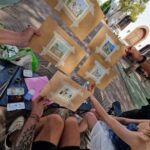
Three hours can change how you order in Málaga. This Spanish crash course at Vamos Academy focuses on the phrases you actually use, plus quick cultural context for Andalusian life.
I especially liked how the class stays practical from minute one, and how the small group format keeps you speaking instead of watching.
I also like the structure. You move through greetings, then cafés and menus, then directions, and finally more “real day” simulations. When I read about sessions led by Natalia from Granada, it was clear why this works: she teaches in Spanish but explains so you keep up fast.
One drawback: this is not a grammar course. If you want deep rules or long conversation practice, you’ll finish with strong survival phrases rather than fluency.
In This Review
- Key things that make this course work
- Where You Start: Vamos Academy near La Malagueta
- Getting Past Hello: Greetings and quick confidence
- Ordering food and drinks without freezing
- Asking for directions in Málaga’s real places
- Real-life simulations: tickets, shopping, and emergencies
- Playa de La Malagueta: why the course includes a beach stop
- English support, Spanish practice, and the rhythm of a crash course
- Price and value: what $106.46 buys you in 3 hours
- Who should take it (and who might want more)
- Quick tips to get the most from your class
- Should you book the Spanish Crash Course for Busy Days in Málaga?
- FAQ
- How long is the Spanish crash course in Málaga?
- Where does the course start and end?
- Is the class taught in English?
- How large are the groups?
- Does the tour include Playa de La Malagueta?
- What days and times is it available?
- Will I get a ticket on my phone?
- Is free cancellation available?
- Can I participate if I’m a complete beginner?
Key things that make this course work
- Small group size (max 10): you get time to speak, not just listen
- Role-play built for real moments: greetings, menus, directions, shopping, and emergencies
- English-led, Spanish-focused practice: you can follow along while starting to think in Spanish
- Málaga-specific culture cues: vocabulary and local slang that makes interactions feel less awkward
- A practical location near the beach: Playa de La Malagueta is right in the course rhythm
Weighing it up? Set it beside a few Málaga favourites first.
- Malaga: Catamaran Sailing Trip with Sunset Option★ 4.4 · 8,613 reviews
- Málaga: Alcazaba and Roman Theatre Guided Tour With Entry★ 4.8 · 5,792 reviews
- Ronda and Setenil Tour with Free Time and Map from Málaga★ 4.8 · 5,344 reviews
- From Málaga: Caminito del Rey Day Trip & Guided Tour★ 4.8 · 4,683 reviews
Where You Start: Vamos Academy near La Malagueta
The class meets at Vamos Academy – Spanish School Malaga, C. Reding, 6, Málaga-Este, 29016 Málaga, and it ends back at the same spot. That sounds simple, but it matters. A central start means less scrambling before class, and you’re positioned close enough to keep the learning going immediately afterward.
This course runs about 3 hours, and you can choose a day Monday through Saturday with flexible hours. The school also lists 9:00 AM to 9:00 PM (Monday to Friday), which is useful if you’re trying to fit Spanish lessons between beach time and dinner plans.
Logistics are smooth: you’ll get confirmation at booking, and you can use a mobile ticket. The meeting point is near public transportation, which is handy if you’re hopping around Málaga on foot and bus routes.
From the review details, the welcome at Vamos can be more than a handshake. One account mentioned modern spaces with plenty of natural light, plus a friendly touch like free coffee and fresh churros to start the morning. Even if you don’t arrive hungry, that kind of casual, welcoming vibe helps you relax—because a “crash course” goes a lot faster when you feel comfortable.
Getting Past Hello: Greetings and quick confidence
Most language classes begin with theory. This one starts with what you need on day one. Early on, you practice basic greetings and polite essentials like hello, goodbye, please, and thank you.
What I like about this part is the sequencing. You’re not learning words in isolation. You’re using them in short dialogue practice, which helps you stop translating in your head. In a crash course, that shift is everything. You’ll feel the difference when you can actually start talking, instead of waiting until you’re “sure” your Spanish is perfect.
You also get a framework for small talk—enough for the common tourist interactions: meeting someone, responding politely, and keeping the conversation moving even if your vocabulary is limited. It’s the kind of setup that makes later scenes (like ordering and asking directions) far less stressful.
Ordering food and drinks without freezing
The next big step is cafés and restaurants, where you practice ordering with role-play. This is where Spanish becomes useful fast, because meals are one of the first places you’ll need the language in Málaga.
The course focuses on:
- How to read and follow a menu when you don’t know every word
- How to ask for what you want
- How to request recommendations
- How to understand common phrases waiters use
One review shared an example of the kind of practice that happens: ordering a caña and patatas bravas, plus the rhythm of asking for what you want politely. Even if your tastes differ, the structure is the same. You learn the “building blocks” of restaurant Spanish—so you’re not stuck each time you face a new dish.
A practical tip: in this part of the class, pay attention to pronunciation cues and question shapes. In many travel situations, people understand you better when your sentence rises at the right moment (asking), and falls in the right place (ordering). Crash course classes are short, so getting your mouth comfortable quickly is the fastest path to confidence.
- Malaga: Catamaran Sailing Trip with Sunset Option
★ 4.4 · 8,613 reviews - Málaga: Alcazaba and Roman Theatre Guided Tour With Entry
★ 4.8 · 5,792 reviews - Ronda and Setenil Tour with Free Time and Map from Málaga
★ 4.8 · 5,344 reviews
Asking for directions in Málaga’s real places
After you can handle basic interaction and meals, you move into directions—one of the highest-impact skills for any short trip.
You practice how to ask where things are, including bus stops, post offices, and landmarks. The goal is not just asking. It’s also listening for simple responses and understanding what they mean in context, so you can follow the direction even when you miss a word.
This section is valuable because directions are rarely “perfect Spanish.” You’ll hear short replies, gestures, and partial sentences. Practicing now trains you to catch the gist: location words, directions, and confirmation phrases.
If you get nervous in real life, this is the section you’ll appreciate most. Role-play makes a strange thing feel normal. You try the question, you hear the response style, and you learn what to do next.
Real-life simulations: tickets, shopping, and emergencies
Then the class switches from everyday routines to the stuff that can suddenly matter. You get simulated everyday situations like buying tickets, shopping, and having casual chats.
You also cover emergencies in a way that’s designed for tourists and quick use. One review specifically mentioned practicing an emergency line like I lost my wallet. Even if you hope you never need it, knowing a ready-to-use sentence makes you feel safer.
This is one of the most practical reasons to take the course instead of relying purely on apps. Apps teach vocabulary. This format teaches reactions: what to say first, what to ask, and how to keep the interaction moving when you’re stressed or confused.
And since the course includes interactive group exercises, you’re not just repeating lines. You’re using them with others, which forces you to respond instead of recite. That back-and-forth is what makes the phrases stick.
Playa de La Malagueta: why the course includes a beach stop
The listed stop is Playa de La Malagueta. Since the activity ends back at the meeting point, you can think of this as a course that stays anchored in a real neighborhood, not just an indoor classroom bubble.
For me, the beach-side connection is smart. It puts you near a place where locals and visitors naturally circulate—so you’re practicing language in a setting that feels like day-to-day Málaga. Even if the exact practice is brief, having that outdoor backdrop matters because it mirrors real timing: you learn, then you walk a few minutes and see how people actually behave.
One note for comfort: the course involves being in the Málaga sun for part of the time. Wear sunscreen and comfy shoes. It’s a beach area, and you’ll get more out of the lesson if you’re not distracted by discomfort.
English support, Spanish practice, and the rhythm of a crash course
The course is offered in English, but it’s built around Spanish practice. That balance matters when you’re starting from scratch. You can follow what’s going on without getting stuck on explanations, and you still build Spanish speaking habits.
In one described class, the instructor Natalia from Granada taught mostly in Spanish but explained clearly enough that even complete beginners could keep up. That style is common in effective crash courses: Spanish is the main tool, but support is built into the teaching so you’re not lost after the first few minutes.
The group size is capped at 10, which is another reason this format works. In a bigger class, you might only get one chance to speak. Here, you’re more likely to repeat phrases, get quick corrections, and practice variations—like changing the question slightly for a new situation.
Price and value: what $106.46 buys you in 3 hours
The price listed is $106.46 per person for roughly 3 hours. That’s not “cheap,” but crash courses often aren’t. The value comes from concentration: you’re paying for human coaching and guided repetition in the exact moments you’ll use on the street.
So where does the value show up?
- You practice core phrases for restaurants and directions, which are high-frequency needs in Málaga
- You get feedback on how you speak, not just what you know
- You do role-play scenarios designed to mimic real interaction
- You leave with usable lines you can deploy immediately after class
One reason people keep comparing this kind of class to language apps is simple: an app can’t correct your tone on the fly or let you practice back-and-forth. This course gives that interaction in a short time window—ideal if you’re only in town briefly.
If your schedule allows it, this lesson can also reduce the friction of your first days. You spend less time “figuring out how to ask” and more time actually enjoying Málaga.
Who should take it (and who might want more)
This experience is best for:
- Beginners who want practical Spanish quickly
- Visitors with short stays who need high-impact survival skills
- People who learn better through speaking practice than grammar drills
- Anyone who wants a guided cultural lens on Málaga and everyday Andalusian habits
The course is also suitable for most people since it’s described as having broad participation potential, and it allows service animals. It’s near public transportation, so getting there is usually easy.
If you’re already conversational and want deep grammar or long discussions, you may find this too short. Think of it as a strong start: functional phrases, confidence-building drills, and direction on what to practice next.
Quick tips to get the most from your class
A crash course rewards preparation. Here’s how to make those three hours count:
- Take notes on the phrases you repeat most in class. Those are your real targets.
- If you freeze in role-play, focus on the first sentence only. Even partial Spanish works.
- After class, use what you learned right away—ordering a snack or asking one direction question in Spanish helps lock it in.
- Don’t worry about sounding perfect. In these scenarios, clarity beats correctness.
Should you book the Spanish Crash Course for Busy Days in Málaga?
If your goal is to start speaking fast, learn what to say for food and directions, and feel more confident in daily interactions, I think this is a smart booking. The small group size and the role-play style are the big selling points, and the fact it’s English-led lowers the barrier for first-timers.
You should consider skipping or adding more time if you want a deep grammatical foundation or long, free-flow conversation practice. This course is designed to get you functional quickly, not to make you fluent by the end of a single session.
If you’re juggling a packed itinerary, it’s the kind of lesson that can pay off immediately—especially when your next meal or ask-for-directions moment is only a short walk away.
FAQ
How long is the Spanish crash course in Málaga?
It runs for about 3 hours.
Where does the course start and end?
It starts at Vamos Academy – Spanish School Malaga (C. Reding, 6, Málaga-Este, 29016 Málaga) and ends back at the same meeting point.
Is the class taught in English?
Yes, it’s offered in English.
How large are the groups?
The maximum group size is 10 participants.
Does the tour include Playa de La Malagueta?
Yes, Playa de La Malagueta is listed as the stop for the activity.
What days and times is it available?
It’s offered Monday to Saturday, with flexible hours. The school’s listed hours are 9:00 AM to 9:00 PM Monday to Friday.
Will I get a ticket on my phone?
Yes, it uses a mobile ticket.
Is free cancellation available?
Yes. Free cancellation is available if you cancel at least 24 hours before the experience start time.
Can I participate if I’m a complete beginner?
Most participants can take part, and the course is designed for practical travel Spanish, so beginners typically do well.
More Málaga Trips, Reviewed
- Malaga: Catamaran Sailing Trip with Sunset Option
★ 4.4 · 8,613 reviews - Málaga: Alcazaba and Roman Theatre Guided Tour With Entry
★ 4.8 · 5,792 reviews - Ronda and Setenil Tour with Free Time and Map from Málaga
★ 4.8 · 5,344 reviews - From Málaga: Caminito del Rey Day Trip & Guided Tour
★ 4.8 · 4,683 reviews - From Malaga and Costa del Sol: Gibraltar Tour
★ 4.4 · 4,483 reviews - Malaga: Teatro Flamenco Malaga Live Flamenco Show
★ 4.7 · 4,254 reviews